We invite you to pray the Rosary with us daily before weekday Masses, and between Sunday Masses.
How to Pray the Rosary
You are invited to Adoration of the Blessed Sacrament from 9 AM to 3 PM in church when school is in session.
Join us every week for Friday Holy Hour with Divine Mercy Chaplet from 3 PM -4 PM in church.
History of Divine Mercy Chaplet
Consider coming to First Friday Adoration from 9 AM until 7:45 AM on First Saturday.
“First Fridays devotion is a practice of honoring the Sacred Heart of Jesus by attending Mass and receiving Holy Communion on the first Friday of each month. It’s part of a broader devotion to the Sacred Heart, which has been a significant part of Catholic spirituality for centuries.” – Focus
Families are welcome to join us for Family First Saturday Mass and Devotions from Our Lady of Fatima with Family Breakfast and Catechesis for all ages.
Our Lady Said:
“My daughter, look at My Heart surrounded with the thorns with which ungrateful men pierce it at every moment by their blasphemies and ingratitude. You at least try to console me, and say that I promise to assist at the hour of death with all the graces necessary for salvation all those who on the first Saturday of five consecutive months, go to Confession and receive Holy Communion, recite five decades of the Rosary and keep me company for a quarter of an hour while meditating on the mysteries of the Rosary, with the intention of making reparation to me”.
We would be so glad to have you join us for some really special things:
1. Catholic Catechesis (Great for asking questions.)
2. The Best Potluck Breakfast on the West Side* (Please bring a dish to share)
3. We have great parents and Religious Sisters supervising kids during the catechesis:
A. The Holy Barbarians (Boys)
B. Daughters of Mary (Elder Young Ladies)
C. Little Flowers (5+ Young Ladies)
D. Sprouts (Wee Little Ones)
4. Rosary after Mass
5. Confession typically available during/after Mass (pending Priest availability)
6. Holy Mass!!!!!
The Potluck and Catechesis are held in the Academy Cafeteria after the Rosary which is after the Mass. You can take the tunnel into the school through the Marian side exit of the parish.
*We will now be hosting a dietary restrictions table for foods reserved for allergen safety.
You will also be able to access the cafeteria prior to mass to drop off food and keep hot food hot.
We hope you will participate in Stations of the Cross on Fridays during Lent.
What are the Stations of the Cross?
Sacred Heart takes an All Souls Pilgrimage to Holy Cross Cemetery on November 2.
In observance of All Souls Day and the Month of the Dead the Church encourages the pious custom of visiting a Cemetery to pray for the Holy Souls, especially those who have no one to pray for them. In fact, the Holy Father extends a plenary indulgence, which we can use ourselves or offer any soul in purgatory, each day from November 2nd until November 8th, under the normal conditions. *
The introduction to the practice of the Enthronement of the Sacred Heart of Jesus in the home and outlined in the following booklet is compiled from excerpts of Raymond Leo Cardinal Burke’s book on the devotion:
The Enthronement of the Sacred Heart of Jesus
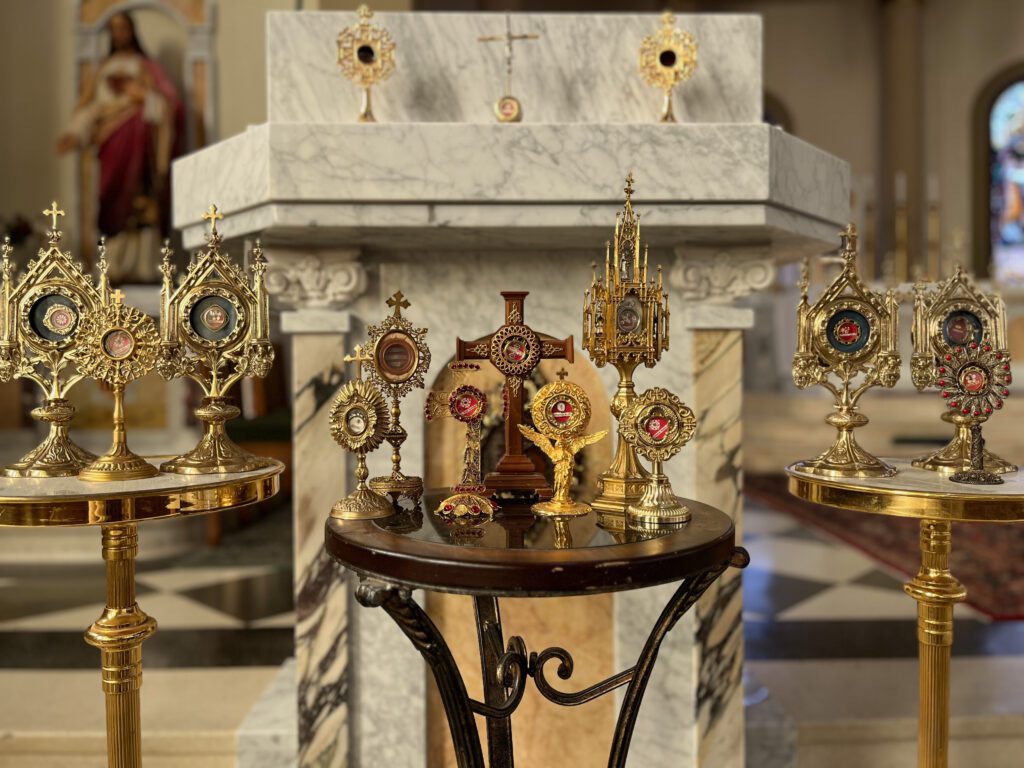
St. Jerome explained relics this way: “We do not worship, we do not adore, for fear that we should bow down to the creature rather than the Creator, but we venerate (give honor to) the relics of the holy ones in order to adore God whose martyrs they are.” Relics remind us that the sacred is in our midst through holy men and women who gave themselves to God as models for us today. Reading the lives of the saints that lived among us is a reminder that God reveals himself to us through their lives and is present to us in the holy men and women that we are able to encounter today.
List of 1st class relics possessed by SHJ:
Pope John Paul II
Luigi Scrosoppi
Charbel Makhlouf
Elizabeth Ann Seton
Francis of Assisi
John Neumann
Patrick
Robert Bellarmine
Thomas Aquinas
Matthew, Mark, Luke, John
Sebastian
Pope Pius X
Anthony Mary Claret
Dominic Savio
Frances Xavier Cabrini
Gemma Galgani
John of God
Maria Goretti
Phillip Neri
Therese of the Child Jesus
Holy Cross
Justin Martyr
Mary Magdalene
Bernadette Soubirous
Francis de Sales
Relic Card Ministry
A collection of relic cards, 3rd class relics of many different Saints, are available in the parish office. These, and others, may be picked up free-of-charge thanks to Kathy Coughlin, who makes these as a ministry for our confirmandi and by special request, to help people “get in touch” with the Saints. Stop by the parish office and look at what is available. Special requests taken. For more information, please contact Mrs. Kathy Coughlin at:coughlinbk@gmail.com.
Blessed chalk available in church after Mass on Epiphany. Information can be found here:
Epiphany Home Blessings
Enjoy May Magnificat with May Crowning is a musical Holy Hour in the Presence of the Blessed Sacrament, featuring a Choral Rosary, the Crowning of the Blessed Mother, and additional Marian Music performed by Sacred Heart Academy School Choirs. Deo Gratias celebration to follow in the courtyard. Please join us as we honor our Blessed Mother as Queen of Heaven!
This is the traditional way to commemorate Our Lord’s entry into Jerusalem. A procession takes place before the 11:30 AM Mass. Learn more here.
Corpus Christi Procession through our Grand Rapids neighborhood (the 2nd Sunday after Pentecost, after the 11:30 Mass).
Corpus Christi Procession
Following are the Prayers after Low Mass which were prescribed by Pope Leo XIII who
composed the Prayer to Saint Michael the Archangel, and were reinforced by Pope Pius XI and
Pope Pius XII to pray for the conversion of Russia. These prayers were in effect until after
Vatican II. A decade later Paul VI said, “satan has entered the sanctuary.” Could the elimination
of these powerful prayers with a ten year indulgence have played a huge part in allowing the
devil such easy access? The answer is obvious. Below the normal Leonine Prayers is the longer version of the Prayer to St. Michael, composed by His Excellency Pope Leo XIII to defend against The Great Apostasy.
Three Hail Mary’s, Hail Holy Queen, St. Michael Prayer
Lent is a season of prayer and penance set apart by the Church to prepare us for Easter and to recall Our Lord’s fast in the desert (cf. Matt 4:1-11, Luke 4:1-13). This season of preparation and sanctification can be fittingly accomplished through voluntary amendment of life, acts of penance, and works of charity. Lent is a time to learn to love our souls more than our bodies. Thus, every Christian should make a special effort to practice mortification and strive for holiness during the forty days of Lent.
Lent is Coming Preparation
The Liturgy of the Hours, also known as the Divine Office or the Work of God (Opus Dei), is the daily prayer of the Church, marking the hours of each day and sanctifying the day with prayer. The Hours are a meditative dialogue on the mystery of Christ, using scripture and prayer. At times the dialogue is between the Church or individual soul and God; at times it is a dialogue among the members of the Church; and at times it is even between the Church and the world. The Divine Office “is truly the voice of the Bride herself addressed to her Bridegroom. It is the very prayer which Christ himself together with his Body addresses to the Father.” (SC 84) The dialogue is always held, however, in the presence of God and using the words and wisdom of God. Each of the five canonical Hours includes selections from the Psalms that culminate in a scriptural proclamation. The two most important or hinge Hours are Morning and Evening Prayer. These each include a Gospel canticle: the Canticle of Zechariah from Luke 1:68-79 for Morning Prayer (known as the Benedictus), and the Canticle of Mary from Luke 1:46-55 for Evening Prayer (known as the Magnificat). The Gospel canticle acts as a kind of meditative extension of the scriptural proclamation in light of the Christ event. Morning and Evening Prayer also include intercessions that flow from the scriptural proclamation just as the Psalms prepare for it.
The five Hours of the Divine Office are: Office of Readings, Morning Prayer, Daytime Prayer, Evening Prayer and Night Prayer. Divine Office Prayers